

Wandering the woods while exploring
what makes each of us unique




Projects
Mushrooms are all around us if you know where to look...
but they may not appear the way you'd think! Some have caps & some do not. Some have gills & some have pores. Some are edible & others are poisonous. Come join me as we see how mushrooms, just like us, come in all shapes & sizes imaginable!
*Disclaimer: I do NOT forage or eat anything I find in the wild!! Not only is it illegal where I live, but I don't trust myself to have the knowledge to correctly discern common edible mushrooms from their trickster look-alikes!
One should never eat mushrooms without cooking them thoroughly as a general rule & one should NEVER attempt it unless they've verified the species with an expert!!


Trooping Crumble Cap
Coprinellus Disseminatus
Also known as "fairy bonnets" or "fairy inkcaps," these tiny mushrooms are part of the fly agaric family. Unlike other coprinoid mushrooms, this one does not dissolve into black ink (deliquesce) when it matures.
Edible: Yes...but it's not recommended
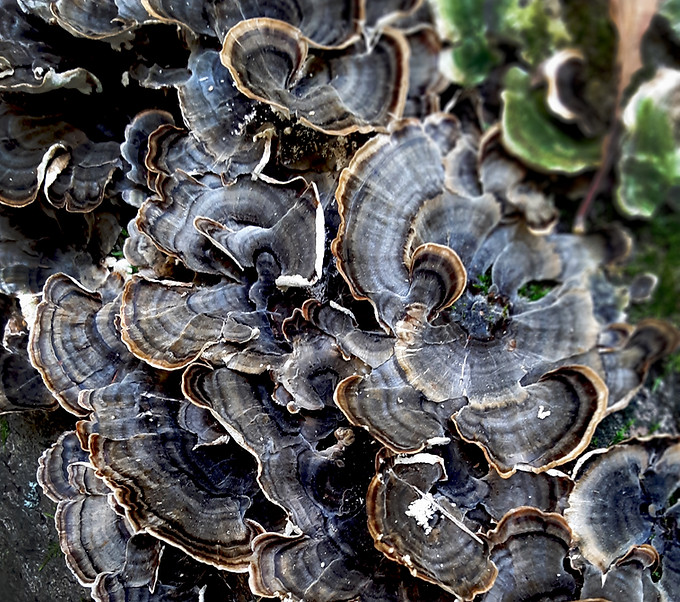
Turkey Tail
Trametes Versicolor
Literally meaning "many colors," turkey tails are common polypore mushrooms that resemble the fan of feathers in the tail of the bird for whom it's nick-named for. Not only is it good for immune health, but it's been part of astounding clinical studies & has been shown to dramatically improve cancer patients' conditions/recovery by assisting the body's natural ability to absorb chemotherapy! Studies are still inconclusive however, & it's not officially FDA approved as a dietary supplement.
Edible: Yes! It's recommended in small uses for immue health & is even an ingredient in some coffee alternatives

Stump Puffball
Apioperdon pyriforme
Also known as "pear-shaped puffball," this autumnal mushroom pops its head (often multiple heads) up on decaying logs. When very young, it's considered edible while still white & is covered in tiny little spines like a hedgehog that fall off when it approaches maturity. As they age, they become darker yellow, green, or brown & a central pore eventually ruptures, to release the inner spores to the wind.
Edible: Yes, but only when young

Coral tooth
Hericium Coralloides
This beautiful fungus looks like it should be under the sea! It likes to grow on dead hardwood trees & its branches grow brittle and more golden as they age.
Edible: Yes, but only when young

Split-gill
Schizophyllum Commune
This mushroom resembles a Chinese folding fan, and is dense but spongey. The caps grow in shelf-like clusters & tend to split down their unusually long gills when the mushroom dries out, hence the name.
Edible: Yes, though there's debate whether or not it causes certain fungal infections or diseases, most notably the lungs. However, it's widely popular in tropical places like Mexico & Northern India, even becoming the favorite of the Mizo community! It's known as "kanglayen" and one of the favourite ingredients for Manipuri-style pancakes called "paaknam"

Mossy Maze Polypore
Cerrena unicolor
This tree-hugging mushroom grows in tightly-packed shelves & attach to the bark without a stalk. The surface is often green from algae, but the part underneath is white in youth & gray in old age. The arrangement of pores resembles a maze, hence where it gets its common name. It's not a friendly decomposer, however--it can cause canker rot & decay to species like birch or sugar maples.
Edible: No